




A Five-Day Immersion into Rigorous Design Research, Collaboration, and Innovation
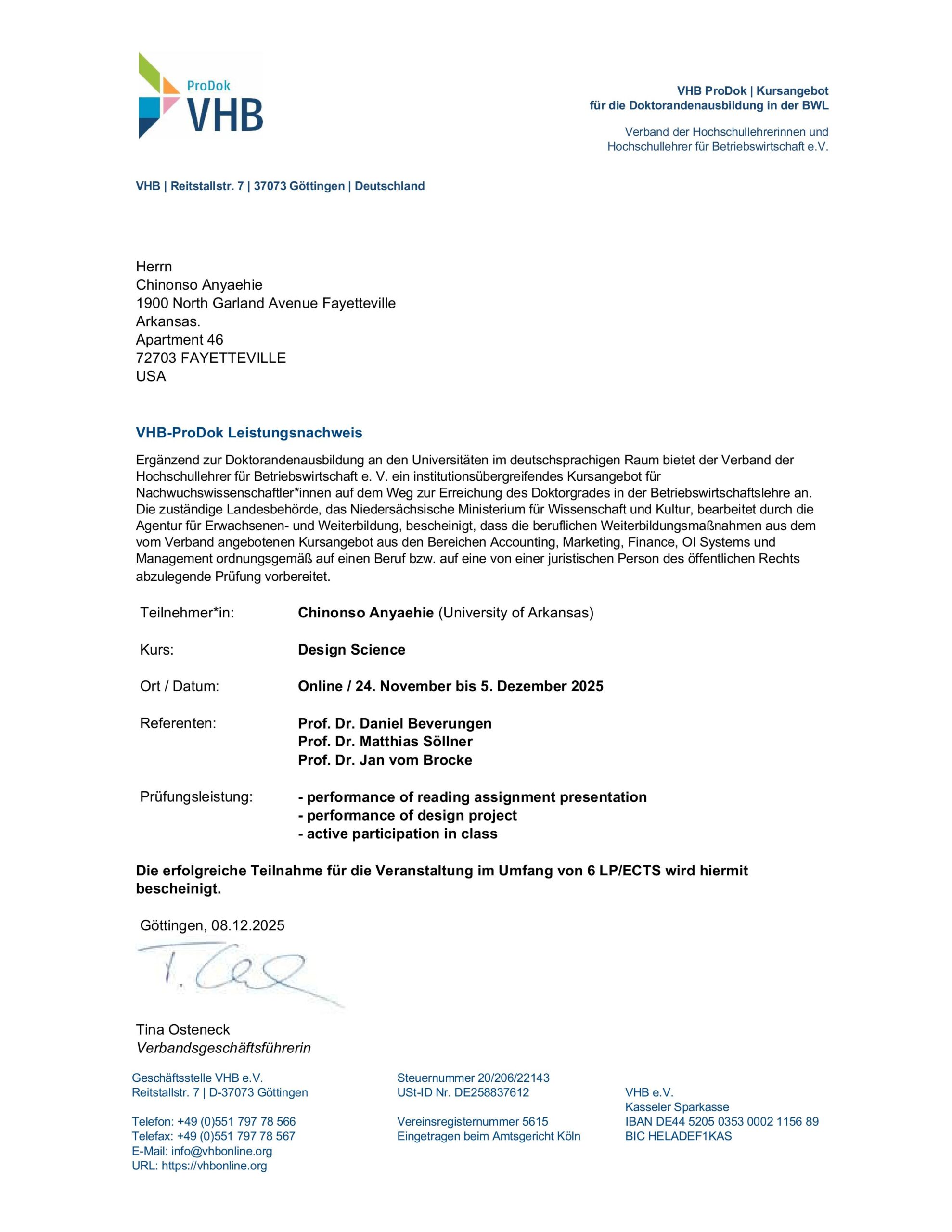
The VHB ProDok Design Science Research (DSR) course is one of the most intensive and rewarding doctoral training programs in Europe, and this year I had the privilege of being part of it. Over the span of five days—supported by pre-course work and multiple group iterations—the program offered a deep, structured exploration of how to design, justify, and present rigorous design research.
A Structured Learning Journey
Before the course even began, participants completed several preparation tasks, including reading foundational DSR papers, choosing a research article to present, and preparing early ideas for a potential project. This ensured that everyone entered the course with shared grounding and a sense of direction.
Across the week, the instructors guided us through a thoughtfully sequenced schedule:
- Day 1 introduced the foundations of Design Science Research and provided the space for participants to present ideas and form teams.
- Day 2 was dedicated to reading assignments and presentations, exposing us to a curated set of influential DSR papers and sparking rich discussions.
- Days 3, 4, and 5 focused on iterative project development, with structured walkthroughs where each group received detailed feedback.
- Day 6 concluded with final presentations and a closing debrief.
Each day built on the last, creating a rhythm of learning, reflection, design, critique, and improvement that mirrors the very essence of Design Science Research.
Exceptional Instruction and Guidance
The course was led by Prof. Dr. Matthias Söllner, Prof. Dr. Daniel Beverungen, and Prof. Dr. Jan vom Brocke—three scholars who are not only prominent in the field but also remarkably thorough and generous with their feedback.
Their teaching style blended structure with curiosity. They walked us through foundational concepts, discussed classic and modern design exemplars, and challenged us to think more deeply about problem framing, artifact justification, evaluation strategies, and theoretical contributions.
Throughout the walkthroughs, their critiques were sharp but constructive. They asked the right questions, pushed us to strengthen our logic, and modeled what rigorous DSR reasoning looks like in practice. Their level of involvement showed how seriously they take the craft of design research.
Collaboration and Learning with an International Team
One of the highlights of the course was meeting participants from different universities, research traditions, and professional backgrounds. The diversity of perspectives enriched every conversation—whether people were presenting papers, sharing research interests, or discussing project ideas during breakout sessions.
My team included Benedict Väth, Paul Rozbitski, Alexander Lossner, Bastian Schieck, and myself. Working together over the course of the week allowed us to combine our strengths, challenge assumptions, and learn from one another.
We spent hours refining ideas, debating choices, and preparing our walkthrough presentations. By the end of the week, we weren’t just a team—we were a small learning community.
Our Design Science Project
Our group chose to explore a problem that affects millions of people: the difficulty of reaching medical practices for appointments, urgent questions, or prescription adjustments.
Despite advances in digital communication, many clinics still depend heavily on phone calls, which often leads to long wait times, dropped calls, and accessibility barriers—especially after office hours. We examined where communication breaks down and how these failures create frustration and delays in care.
Over several iterations, we designed a concept for a multi-channel digital communication system that allows patients to reach their medical providers reliably, efficiently, and at any time. Each walkthrough helped us refine our problem framing, improve our justification, strengthen our design principles, and clarify the system’s contribution.
A Week of Growth and Inspiration
What stood out most during the course was the experience of hearing other researchers present their ideas. Listening to participants share their project challenges, design approaches, and evaluation strategies provided a rare window into how design science is practiced across different contexts.
The instructors also shared numerous examples of exemplary DSR studies, walking us through their logic, structure, and impact. These moments were incredibly valuable—they helped translate abstract principles into concrete research strategies we can apply in our own work.
Final Reflections
This course was more than a training program. It was:
- a deep academic immersion,
- a collaborative creative process,
- a space to grow as a design researcher, and
- an opportunity to connect with talented scholars from across universities.
I left the program with a stronger understanding of Design Science Research, new collaborators, and renewed motivation to design research artifacts that solve meaningful problems.
This experience strengthened my passion for DSR—one originally inspired by Professor Amber Young—and confirmed for me that design is not just a methodology but a mindset.


Leave a Reply