




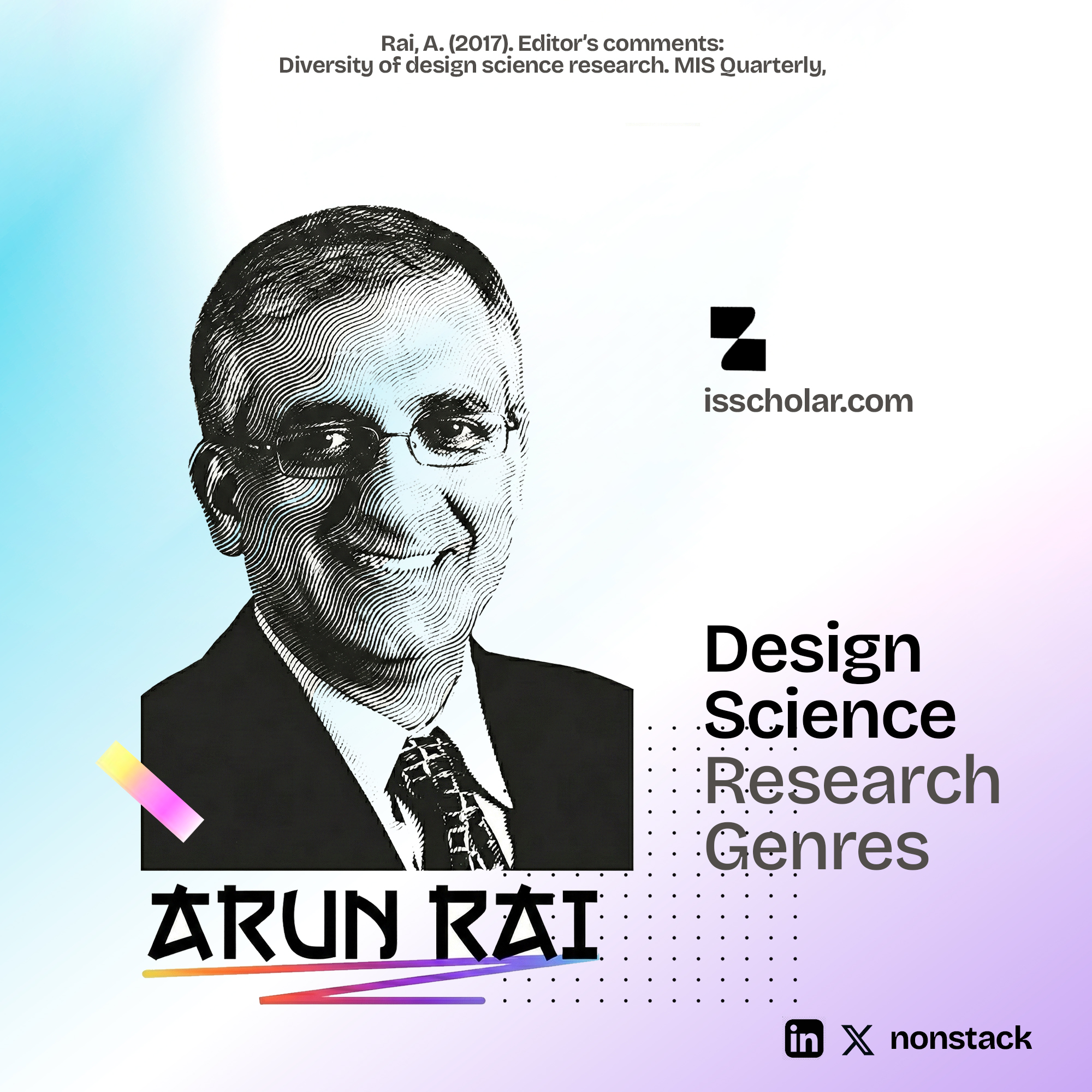
In order to understand the design science research paradigm you first have to have a thorough understanding of the different genres that exist in this area as many researchers do not know what type of solution they are going to provide when writing their papers in this space. Therefore, the ability to clearly state your contribution and how it differs from other work should be the first hurdle you have to overcome. In the editorial “Diversity of Design Science Research,” there are four genres of Design Science Research identified; each entry contains the focus, activities, goals, and an example of a practical application in The Problem, The Solution, and Why it Fits.
1. Computational Genre
- Focus: Develop computational models and algorithms to solve business and social problems.
- Key Activities: Use an interdisciplinary approach to develop new data representations, computational algorithms, Business Intelligence/Analytics Methods, and Human-Computer Interaction (HCI) Innovations.
- Goal: Create high impact and relevance by developing new solutions for important problem domains (for example: Healthcare, Cybersecurity).
- Practical Example: Health Analytics (Lin et al. 2017)
- The Problem: The need for effective risk profiling in chronic care management, which requires coordinating and learning from multiple, disparate health events.
- The Solution (Artifact): A Bayesian multitask learning model. This is a novel computational algorithm designed specifically to coordinate and learn from these multiple health events.
- Why it fits: It fits the computational genre because the primary contribution is a novel algorithm/technique (Bayesian multitask learning) developed to solve a complex data-centric problem, rather than just applying existing tools.
2. Optimization Genre
- Focus: Solving operational and decisional problems by developing optimization models, related models, and heuristics.
- Key Activities: Using mathematical programming, decision theoretic techniques, or simulations to model business problems and identify optimal design choices.
- Goal: To propose prescriptive solutions that change how information systems function (e.g., supply chains, pricing) to better solve real-world problems.
- Practical Example: Data Privacy (Menon and Sarkar 2016)
- The Problem: The challenge of hiding sensitive data (patterns) in large transactional databases so they can be shared without compromising privacy.
- The Solution (Artifact): An integer programming model (a mathematical optimization formulation). The researchers framed the privacy issue as a “set covering problem” to mathematically determine the optimal way to sanitize the data.
- Why it fits: It fits the optimization genre because it frames a business problem (privacy) as a mathematical optimization problem to find the “best” solution (max utility, min privacy loss).
3. Representation Genre
- Focus: Representing complex phenomena by developing methods and grammars.
- Key Activities: Designing and validating modeling grammars (constructs/rules), scripts, or methods to facilitate the faithful representation of real-world phenomena within an information system.
- Goal: To ensure the system faithfully represents stakeholders’ perceptions of the domain, which leads to a more effective information system.
- Practical Example: Healthcare Data Quality (Burton-Jones and Volkoff 2017)
- The Problem: Maintaining high-quality data in community-care electronic health records is difficult because different users (e.g., clinicians vs. admins) operate at different levels—some need “instance” data, others need “class” level data, leading to conflicts.
- The Solution (Artifact): A contextualized theoretical model. This artifact helps resolve conflicts between these different levels (instance, part-whole, and class) to ensure the data accurately reflects the complex reality of patient care.
- Why it fits: It fits the representation genre because the solution focuses on faithfully representing the domain (patient care levels) in the system, rather than just processing speed or economic efficiency.
4. IS Economics Genre
- Focus: Solving problems related to economic activities and systems by designing mechanisms for conducting activities and economic exchange.
- Key Activities: Designing IT-based artifacts (e.g., control or feedback mechanisms) that explicitly account for economic characteristics like incentives, decision rights, and market rules.
- Goal: To understand how IT functionalities can enable the design of mechanisms for economic activity and help attain the objectives of the economic systems in which they are embedded.
- Practical Example: Sustainable Energy (Ketter et al. 2016)
- The Problem: The difficulty of designing sustainable energy systems that must account for complex interactions between consumer usage, production, and government regulations.
- The Solution (Artifact): A competitive gaming platform. This software artifact functions as a market mechanism where different strategies and regulatory regimes can be tested by agents.
- Why it fits: It fits the IS economics genre because the artifact is designed based on economic characteristics (market rules, incentives) and is used to discover how to design a better economic system (energy market).
Although these four genres of Design Science Research – namely, Computational, Optimization, Representation, and IS Economics – provide different ways of thinking about research within Design Science Research, they represent neither an exhaustive set of possible approaches to Design Science Research, nor are they mutually exclusive of one another. All of these genres have as their overarching goal (the development and evaluation of) developing new and/or improved IT-based artifacts to solve real-world problems while contributing to our body of scientific knowledge. No matter whether a researcher is developing new algorithms, improving how decisions are made through optimization, providing faithful representations of reality, or designing mechanisms that operate according to certain economic principles, each genre represents a formalized path by which IS researchers can become involved with the “sciences of the artificial,” and transform current circumstances into preferred circumstances.



Leave a Reply